

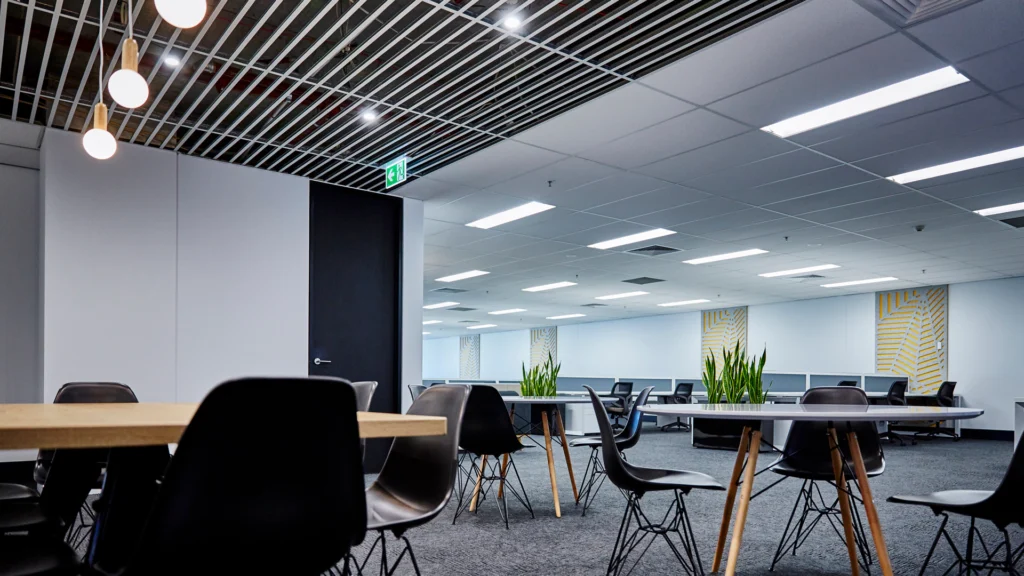
Step into a modern commercial space and the atmosphere would feel empowering, dynamic, and refreshing. The walls appear crisp and balanced, the ceilings feel calm and controlled, and the layout feels purposeful rather than accidental. That refined experience comes only from a thoughtfully tailored commercial fitout. At the heart of that process sits Lined Plasterboard.
Lined plasterboard has become the backbone of commercial fitouts across offices, retail spaces, hospitality venues, and institutional buildings. But why is it the go-to material?
Let’s find out!
Understanding Lined Plasterboard in Commercial Interiors
Lined plasterboard refers to gypsum panels installed as finished wall and ceiling linings. Each board contains a solid gypsum core with protective paper layers. That composition delivers strength, stability, and surface consistency.
Typically, most commercial fitouts depend on lined plasterboard for spatial definition. The boards create walls that separate functions and guide movement. They also shape ceilings that control acoustics and lighting.
Unlike raw structural elements, plasterboard creates a refined internal shell. That shell allows designers to apply paint, textures, and finishes easily. So, the interior achieves both polish and practicality.
Lined plasterboard suits commercial projects of every scale. From small retail tenancies to large office floors, every setting benefits. Because the boards install cleanly, contractors can ensure quality workmanship and required momentum on site. This makes project timelines remain predictable and manageable.
Also Read – Sustainable Practices in Commercial Office Fitouts
Speed and Efficiency Drive Commercial Decisions
Time defines success in commercial office fitouts. Every little delay costs money and damages brand reputation. But lined plasterboard can avert this issue by directly supporting faster construction schedules.
The boards arrive ready for installation, and workers handle them without heavy machinery.
Once installed, plasterboard requires minimal curing time and painters can begin finishing soon after the installation. For businesses preparing to open doors, this speed equals opportunity.
Traditional masonry cannot match this pace, for they demand drying periods and extended labour hours. Plasterboard, on the other hand, eliminates those bottlenecks entirely. As a result, lined plasterboard becomes an obvious material choice.
Also Read – Office Fitouts for Hybrid Work
Design Freedom Shapes Modern Commercial Spaces
Commercial interiors demand personality and identity and lined plasterboard can allow that creative freedom. The boards support straight planes and sharp corners, while also allowing curves and layered forms when required. That adaptability suits modern and experimental designs.
Further:
- Bulkheads create visual hierarchy across open spaces.
- Recessed lighting adds drama and direction.
- Feature walls provide focal points for branding.
All of these elements rely on plasterboard systems because the material accepts shaping without compromising strength. So, designers are able to push boundaries without structural risk.
Also Read – How long does an Office Fitout take?
Acoustic Control Matters in Commercial Fitouts
Noise management defines comfort in all kinds of settings, especially in commercial environments. For example, offices require focus and clarity, while restaurants require an atmosphere without chaos. Lined plasterboard supports such acoustic performance effectively. Specialised boards reduce sound transmission between spaces, and insulation layers enhance that control further.
These features help a diverse range of spaces.
- Meeting rooms benefit from speech privacy.
- Healthcare facilities benefit from quiet circulation areas.
- Educational buildings benefit from controlled learning environments.
Without proper acoustic lining, productivity suffers quickly. Plasterboard systems address that challenge directly, so businesses maintain functional harmony across spaces.
Also Read – Benefits of Biophilic Design in Office Fitouts Melbourne
Fire Safety Remains a Non-Negotiable Requirement
Commercial buildings face strict fire regulations. That is why material selection plays a critical role in compliance. And lined plasterboard supports the fire resistance standards reliably and perfectly. Fire-rated boards slow flame spread during emergencies, providing valuable evacuation time for occupants. So, risk reduces significantly.
Insurance providers recognise these benefits clearly, and building authorities enforce these standards rigorously. As a result, plasterboard remains essential for compliance.
Cost Control Influences Every Fitout Decision
Budget management drives commercial construction outcomes. Clients demand using quality material without unnecessary expense, and lined plasterboard ticks all boxes.
- Material costs remain competitive across large projects.
- Labour requirements stay predictable and efficient.
- Maintenance needs remain minimal over time.
Damage repairs also require simple patching techniques. Entire wall replacements become unnecessary. So, long-term costs stay manageable.
Compared with alternative materials, plasterboard offers great value which appeals to developers and businesses alike.
Consistency Improves Project Quality
Commercial fitouts require consistency across large areas. It ensures visual continuity and reinforces professionalism. For that, lined plasterboard is the perfect choice.
Boards install with consistent thickness and finish, while joints disappear beneath skilled finishing techniques. This makes surfaces appear flawless under lighting. It also simplifies coordination between trades. For instance, it lets painters and decorators work with confidence and ensure controlled quality.
Skilled Installation Makes the Difference
Material quality matters but only when paired with skilled installation. Commercial plasterboard demands precision and expertise, and poor workmanship undermines every advantage that it has to offer.
Professional installers measure accurately, cut boards cleanly, and finish joints flawlessly. Their attention to detail separates average results from excellence. So, working with experienced teams remains essential.
Lined Plasterboard in Real Commercial Applications
Here are some real scenarios for better understanding:
- Office fitouts rely heavily on plasterboard partitions. These systems allow flexible layouts and future reconfiguration. So, businesses can adapt without major reconstruction.
- Retail spaces use plasterboard for branding features. Display walls and lighting elements integrate seamlessly. This improves customer experience through design.
- Hospitality venues depend on plasterboard for ambiance. Ceilings shape sound and mood, while walls support decorative finishes and lighting.
- Medical facilities require hygiene and plasterboard delivers just the same. It offers smooth and easy-to-clean surfaces, ensuring better compliance.
Conclusion
Lined plasterboard stands at the core of commercial fitouts. It shapes spaces that feel modern and purposeful. From first fix to final finish, it delivers value and works quietly behind every polished interior. That is why lined plasterboard remains the go-to material for any commercial fitout project.
If you want to tailor your space with lined plasterboard, feel free to connect with our experts at Juma Projects.